
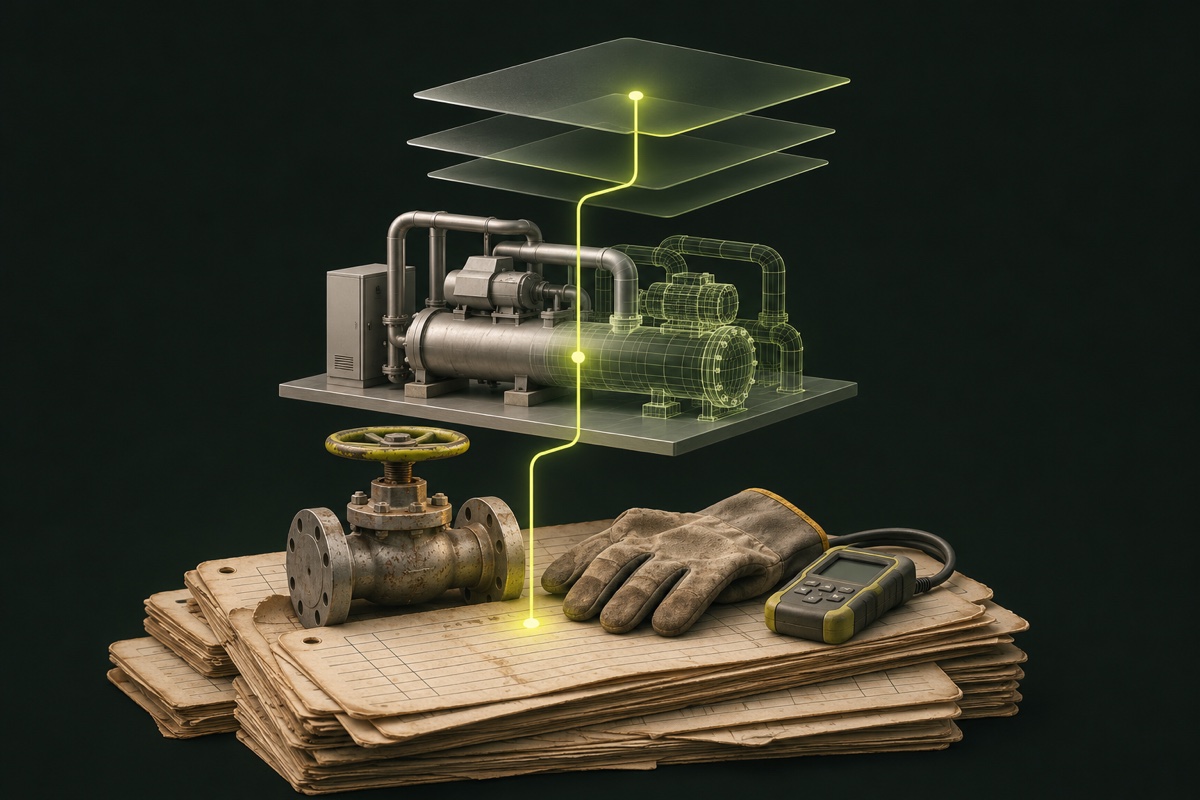
In the space of about a day, I watched three people at three different altitudes describe the exact same machine.
At the top, the research framing. The hard problem in physical AI is not only the model. It is teaching a system to keep learning and to generalize to conditions it has never physically encountered: novel failures, novel environments, long stretches of autonomous operation with only intermittent contact with a teacher.
In the middle, the builders. A head of go-to-market at a robotics simulation company put it plainly this week: real-world data is essential for validation, but the opportunity is using that data to build environments where teams can systematically explore conditions they haven't physically tested. The value is not reconstructing a scene. It is whether the simulation supports real training and evaluation across those variations.
At ground level, the trades. An HVAC industry CEO published his map of the next decade: equipment, AI, digital twins, real-time data, field service, secure control, all converging into one operating environment. His stack ends with glass on a technician's face and, to his credit, he names the missing layer himself. As AI moves from recommending actions to taking them, somebody has to answer: who is standing at the machine, what are they authorized to do, was the action recorded, and can it be verified later?
Research, simulation, and the mechanical room are not three stories. To my eye, they are one story told at three heights.
But the pricing question needs a narrower frame.
Newly captured human work is already being commissioned and priced. Routine demonstrations can be repeated and collected to a specification. Archive Signal is building capture relationships too. The question here is about existing operational records, especially rare episodes where something went wrong and a person worked out how to fix it.
Think of a pour that failed at hour six. A chiller fault that three alarms described wrong. The sequence of tests, attempted fixes and results that led the senior technician to a workable answer. New capture can document future episodes. It cannot recreate that exact past event under its original conditions, with the original decisions and outcome. An existing record may preserve evidence of what happened then.
In the HVAC example, new work is recorded and its outcome becomes part of "the machine's future knowledge base." That is a useful vision of how a record gets made. It also raises a question about the history a business already holds: when that history enters the knowledge base, what is being licensed, and on what terms?
The historical record is perishable. Retention settings and company closures can erase it. Keeping it does not automatically make it useful training data: context, completeness, rights and a buyer's actual requirements still matter. Who can license it, under what rights and with whose permission has to be established before it is put to a new use.
These three perspectives show why an existing record might matter. They do not establish what anyone is paying for it. The question for an owner is whether that history is being evaluated as an asset in its own right, or included in a wider platform or service arrangement without a separate valuation.
The first step is not a marketplace or a bidding war. It is owners understanding what they are holding before agreeing to a platform contract, a service arrangement or a data clause. Keep the record. Know what it contains. Paper who can use it, for what, and for how long.
The stack is being built either way. Owners of existing operational histories should know what they can authorize and what they are being asked to contribute before its value gets divided up.
Drew Clement is building Archive Signal: rights-cleared, outcome-linked physical data. The answer keys AI trains against.
- Emerson S (Dirac Robotics), public reply to the author on X, November 14, 2026, on using real-world data to build environments for systematic training and evaluation across untested conditions.
- Joseph Callahan III, The Next HVAC Interface: AI, Glass, Digital Twins and the Rise of Physical Intelligence, LinkedIn, November 8, 2026. The phrase “the machine’s future knowledge base” appears in his technician-interface example.
- The research framing is paraphrased from a private exchange. No identifying details or direct quotation from that exchange are published.
The connection between these perspectives, and the argument for preserving and evaluating existing operational histories, are the author’s analysis. These sources do not establish a market price or show that records are being transferred for free. Archive Signal works in data origination and licensing and may benefit if markets for operational records develop.
Updated November 16, 2026: distinguished new capture from existing operational histories, removed the unsupported zero-price claim, and corrected the image-caption spacing.